shoulder blades: most of the upper back muscles attach to them directly, placement is affected by the arms. They can get obscured on very muscular backs, but most people these are the most dominant features!
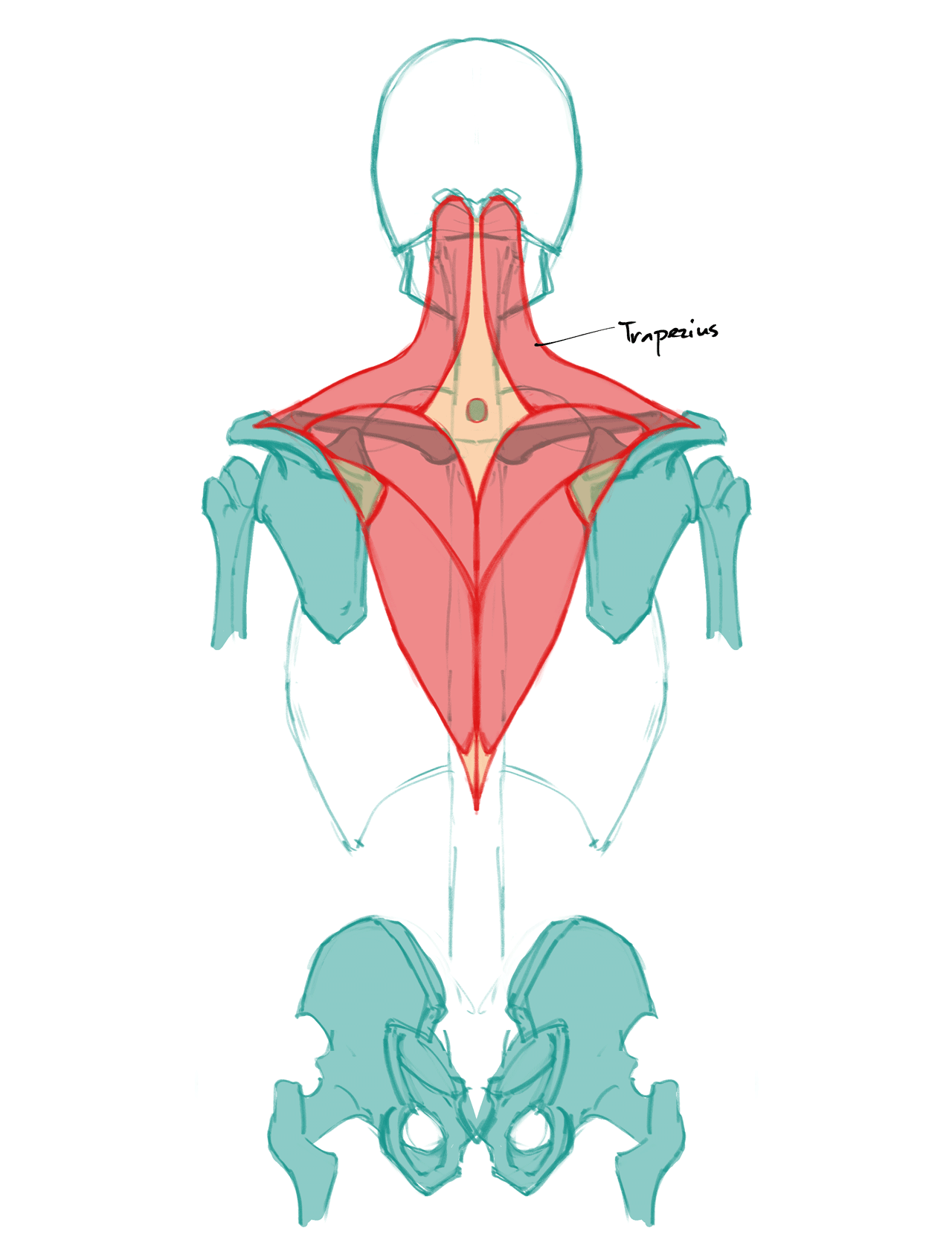
7th cervical vertebra: neck bone that sticks out in most people, it sits in the center of that diamond shaped tendon in the middle of the trapezius
Also, obviously always keep the general shape of the ribcage and spine in mind, it was too much of a pain to draw them all in lol.
BACK MUSCLES
Erector Spinae: make the column-like structures around the spine,
they extend all the way up to the neck, but you really only see the
bottom part.
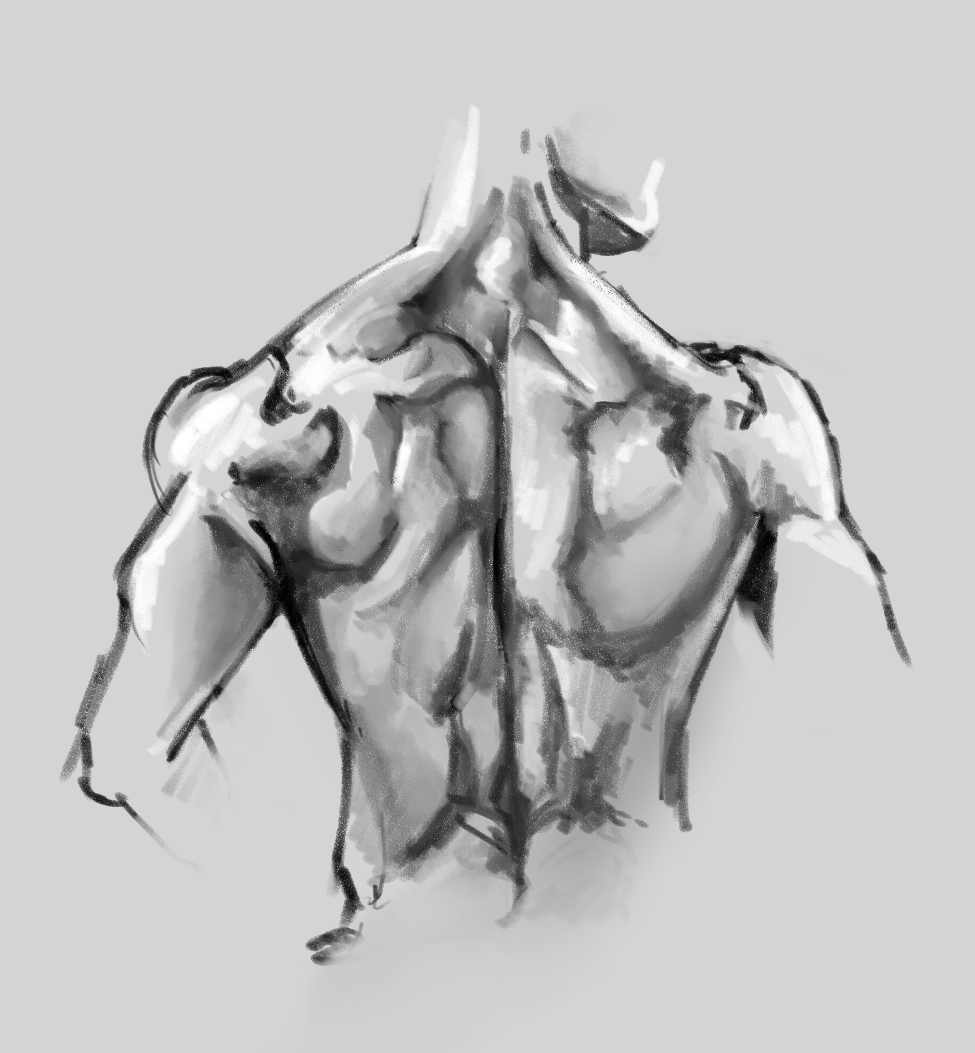
Latissimus Dorsi: are very thin, so most of the time you only see the structures underneath (such as the erector spinae). But when flexed, (for example, when climbing), you can see here on Jimmy Webb’s back that swooping curve it makes under the armpits.
The lats are also responsible for most of a person’s upper body strength and are the “V” shaped part of the back. For example, it’s how Bruce Lee was so strong despite being a small guy. Just look at those wings, man.
Infraspinatus, Teres Minor, and Teres Major:
sit on the shoulder blade itself, and connects it to the top of the arm
bone. These are responsible for a lot of the crazy shapes you see in
bodybuilders’ backs.
Underneath them is the serratus anterior, which technically isn’t a back muscle but sits on the side of the ribs. These form that zig-zag pattern on the ribs that makes people look super ripped when visible with the external obliques, both wrapping around the sides of the torso. They’re not technically back muscles but fill out the silhouette, so it’s good to keep them in mind.
the glutes/butt muscles… they go farther up the back than one might assume and they, along with the pelvis, do affect the surface appearance of the lower back.
Rhomboid: simple shape, attaches from the inner edge of the shoulder blades to the middle of the spine at the 7th cervical vetebra to about the 4th or 5th thoracic vetebra. It does not overlap with the latissimus dorsi
Trapezius: divided roughly in the top, middle, and bottom sections. The top is quite thick and cylindrical and makes the sloping shape from the neck to the shoulders.
The bottom part is very thin; like the latissimus dorsi, the forms underneath it are visible when relaxed, making the rhomboid visible if it is flexed and the traps are not. Also not where the bottom part’s tendons attach to the shoulder blades; it outlines the curve of the shoulder blades even in people who are covered in brains muscles.
When fully flexed, it doesn’t taper into a point, but makes a small “w” shape at the bottom.
The 7th cervical vertebra sits at the center of the diamond-shaped tendons between the first and second sections of the trapezius. This part appears recessed in very muscular people.
Deltoid: not really a back muscle, but they overlap with the Infraspinatus and insert into the upper ridge of the shoulder blades, so it’s good to see how they interact with the others.
Ah, now for an example, featuring Thor himself. Note the curve where the traps meet the shoulder blades, the diamond-shaped tendon, and the rough “w” shaped contour of the lower back. Also note the two dimples, which is formed by the pelvis bones. They tend to be more prominent in women, although they are found in both men and women.
Try to find the back muscles on other people yourself, and then GET DRAWING
(PS, Generally it’s best to be able to simplify the forms instead of trying to render straight away – that’s how you know you really internalized the anatomy! I… honestly still don’t understand the back enough to do that yet, hence the lack of examples, unlike with the forearms post. But nonetheless, I hope that this is still useful as a general reference. I know it’s helped me at least remember what the different parts are, even if I don’t yet have a grasp of how they interact in motion!)
SAI brushes for Clip Studio Paint (Manga Studio 5) + 1blender
My brushes for Manga Studio 5 or Clip Studio Paint like SAI watercolor, pencil, and pen plus one blender brush. They are made to emulate Paint Tool Sai’s watercolor brushes.
If you love beautiful manga art this set is for you…
my advice: have fun and play–play is learning | always be watching real life to see how things move | also be watching cool animations to learn from them | it’s hard but so worth it when things turn out well, good luck!
Ah! Well I thought I posted it but I suppose I never did, whoops! This is made using Photoshop CS6. Hopefully its simple but detailed enough. However if not I would recommend looking up some vids on making patterns, there are a lot out there!
This is one of my most asked questions so I am going to try and offer what advice I can. It certainly did not make any sense to me years ago and I would have liked a bit of help.
To preface this entire guide will be from the perspective of an artist attracting an audience for their work that is interested in buying and supporting their art.
Understanding and reaching the audience.
These are the people you want to see your work. If you are trying to create something commercially viable you must always keep the audience in mind. What matters to you is often lost on them and it is easy to lose track of that when you are emotionally involved in your work.
Everything I discuss from here on is centred around the audience and how they will potentially regard you and your artwork.
1. Time does not matter to the audience.
I see this brought up a lot. “I worked very hard for a long time on my art, someone else did not, why don’t people appreciate that.”
To be incredibly blunt, why should they? Two artists create two similar pieces of work. One took 3 days, one took 3 hours. Both are at the same technical level and a similar concept. Why should one be “worth” anything more to the audience, who only sees the end result.
Time rarely matters to the audience. An audience with no art background of any kind will find it very hard to judge how long someone spent on a piece of art (especially digital art) unless-
It’s very clear. A huge traditional painting for example, with something for scale. A linked video showing the process.
The artist states the time taken somewhere. Again, this is only really going to matter to the audience if it surprises them or justifies their own assumptions about the work. (It looks good, but they work quickly, how do they do it!)
I know there will be exceptions. People who really appreciate art will understand and recognise the time taken to create it. You aren’t leaving your success to exceptions though. You need to work with the majority.
Taking a long time to produce a piece of work only really informs your potential audience that they are going to have to wait a while to receive the content. If the work or the concept behind it are strong enough this is not a problem. It hurts an unknown artist trying to establish themselves though for the following reasons…
2. Your upload schedule.
People like consistency and the best way to capture any kind of audience in media is with quick regular uploads of content they are prepared for, are looking for or easily understand. I will list a few things that I feel an audience appreciates or deviates towards.
A regular upload schedule, be it daily, twice a week, even once a month. As long as it is clear. This is a great way to keep viewers coming back to you once they find your work and are happy with the content you appear to be providing.
The time you upload matters. If you post your artwork while the world is asleep no one is going to see it. On sites like tumblr this is even worse, hours can go by and your work will be pushed further and further down the audiences dashboard.
Consistent content. It’s great to try new stuff, but unless your audience knows you for it it could possibly confuse people browsing your page or site. Artists often get categorised as “The dude that draws X, Y Z” for a reason, it’s just easier for an audience to understand.
Do not add unnecessary comments to posts. Nothing puts people off more than 2 paragraphs of text explaining the process or a personal story on why it took so long. Save that for a separate post, consider that your audience needs to share your image. Make it as easy to share as possible.
3. Your content and the concept.
Content is important. Your finished artwork can be technically beautiful, but if there is nothing there for people to understand or relate to they will have no reason to care, or they will be purely judging your work on its level of technical ability.
That can only go so far if the content is too strange, specific or incomprehensible. Very few people are going to share a technically impressive piece of work if it disgusts confuses or upsets them in some other aspect.
Vice versa, a strong or interesting concept can take very simple artwork a very long way. The perfect storm is to have both a fantastic concept and strong artwork working together, but you must consider how much work that will mean you have to do and how fast can you do it. Find a balance.
What grabs an audience varies greatly. You can build up your own brand with your own ideas concepts and characters as long as there is a consistent theme. More often than not an audience will look for:
Things they recognise
Things they can understand at a glance
Things that are relevant to them and their lives
Consider these examples, try to consider which one has the most immediate appeal to the general public:
4. Make things easy for them, some important general advice.
Upload on as many sites as possible, and where appropriate. (No one on a website purely for webcomics is going to appreciate your oil paintings, for example).
Join forums, sign up for art sites. Get to know people and make contacts to get your work out there. Understand the audience on the sites you frequent and what content they do and don’t enjoy. This takes time, this does not happen overnight. You have to commit and find your own path here.
The audience will not just come to you. You need to be proactive. You have to get out there and find them, but be careful, nobody likes to feel like they’re being sold something.
Wherever you post your art, MAKE IT EASY FOR PEOPLE TO FIND AND SHARE! Tag, list and group your content. Tags allow people to find things they already like, make use of that. Give them as few reasons as possible not to share your content. Put yourself in the shoes of the audience and think about what they would and would not want to share with their friends and people that know them.
To conclude
I hope this will give some people who are really lost a few extra ideas when it comes to creating commercially viable content. It upsets me to say this but sometimes there are ideas that, no matter how beautifully illustrated or conceptually brilliant, will just not resonate with certain groups of people.
This is a sad reality, but if this is an issue for you don’t worry. Use this information to create content you know people will enjoy, make a profit from that and then when you have the time and money make the things you really want to make.






 Hauntedlattesbackup